
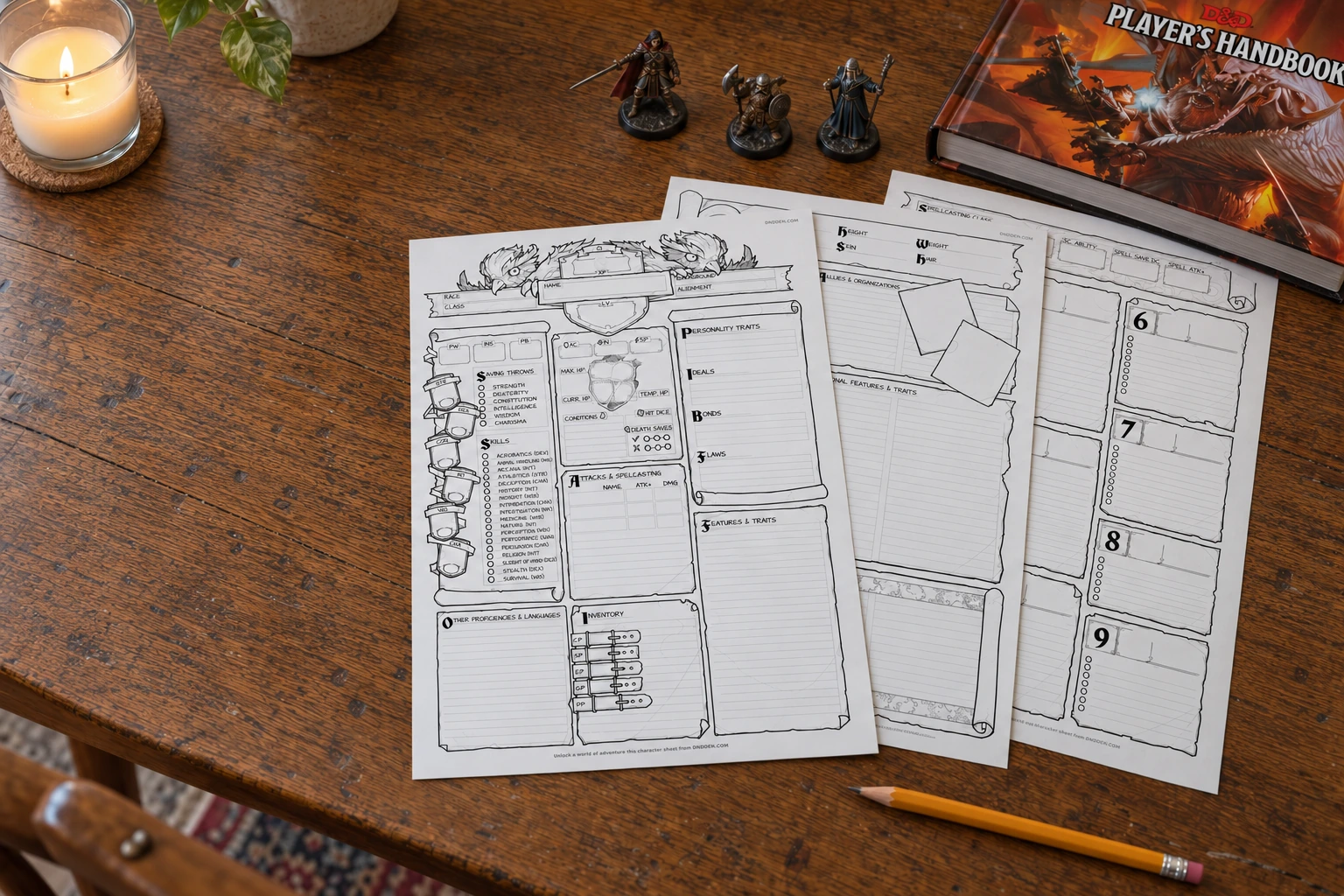
To create a Dungeons & Dragons character, agree on the rules with your Dungeon Master, choose a class and origin, assign ability scores, select your equipment, and calculate the numbers you will use during play. Finish with a reason to join the adventure and a short practice turn. You can begin with a simple concept and develop the personality at the table.
This guide explains how to make a dnd character using the revised 2024 rules, also called 5.5e, at level 1. Our complete example is Mara Vale, a Human Fighter with the Soldier background. Her choices use the free rules, require no multiclassing, and include every essential calculation. A separate section explains the main differences for a 2014 campaign.
Your finished example at a glance
If you want to play this character immediately, use the following summary and work through the choices below to understand it. Mara is an original example, and you can change her name, appearance, and history without changing these mechanics.
| Choice or statistic | Mara Vale at level 1 |
|---|---|
| Rules and class | 2024 Fighter 1; no subclass yet |
| Origin | Human, Medium size; Soldier background |
| Ability scores | Strength 17, Dexterity 13, Constitution 15, Intelligence 10, Wisdom 12, Charisma 8 |
| Main equipment | Chain Mail, Shield, Flail; Greatsword and Javelins as alternatives |
| Main attack | Flail: +5 to hit, 1d8 + 3 bludgeoning damage |
| Defenses | Armor Class 19 with Shield; 12 maximum Hit Points |
| Other essentials | Speed 30 feet; Initiative +3; Proficiency Bonus +2 |
| Feats | Savage Attacker, Alert, Defense |
| Practical role | Armored weapon user who helps allies and handles physical obstacles |
| Main limitations | No spellcasting; ordinary ranged accuracy; noisy heavy armor |
The numerical choices follow the 2024 creation rules and the licensed SRD 5.2.1 rules reference. This is a useful first character, rather than a claim that one combination suits every campaign.
Before choosing anything, get the campaign basics
A character is part of a shared game. Your first task is to find out what that game expects. A detective in a city campaign may need different skills and connections from an explorer in a wilderness adventure.
Ask your Dungeon Master, or DM, for six decisions:
- Rules version: 2014 or revised 2024, with any specific house rules.
- Starting level: This walkthrough starts at level 1.
- Available books: Confirm whether only the free rules, the Player's Handbook, or other supplements are allowed.
- Ability-score method: Standard array, point buy, or rolled scores.
- Starting equipment: Use the normal packages unless the campaign provides a different arrangement.
- Campaign premise: Learn why the party is together and what kinds of adventure to expect.
This conversation also prevents expensive or time-consuming mismatches. You do not need to buy a supplement for a character option the table is not using. If your group provides ready-made characters for a first session, trying one can help you discover which choices interest you.
Pick a record you can read comfortably. The DnDDen character-sheet resource offers a printable traditional layout, while the official character-sheet page links edition-specific options. DnDDen's general PDF is a printable sheet, not an interactive form with built-in typing fields. A 2024 layout makes the revised terminology easier to follow.
Step 1: Give your character a playable idea
Start with one sentence that suggests both an activity and a reason to adventure. “A former guard trying to find a missing caravan” is immediately useful. It tells the DM what you care about and gives you a reason to travel with other people.
Mara's concept is: a former caravan guard who wants to find the travelers she failed to protect. She knows how to fight, watches people carefully, and trusts actions more readily than promises.
Avoid making the first concept depend on abilities a beginner does not possess. A level-1 character can admire legendary dragon slayers without already having defeated several ancient dragons. You can preserve an ambitious idea by making it a goal, family story, reputation, or misunderstanding.
Also give the character a reason to cooperate. A suspicious wanderer can still keep an agreement with the party. A reckless treasure hunter can care about getting everyone home. Character tension becomes more enjoyable when it creates decisions without repeatedly preventing the adventure from starting.
Step 2: Choose the class that matches your main activity
A class provides the central abilities you use during adventures. Think about what you want to do repeatedly, including on an ordinary turn when spectacular resources are unavailable.
| What sounds enjoyable? | Classes worth reading first | Decision to consider |
|---|---|---|
| Using weapons and choosing positions | Fighter, Barbarian, Rogue | Direct fighting, endurance, or precise opportunities? |
| Combining martial action with magic | Paladin, Ranger | Supportive presence or exploration and tracking? |
| Fast movement and unarmed combat | Monk | Do you enjoy managing several tactical options? |
| Helping allies through flexible magic | Bard, Cleric, Druid | Performance, divine magic, or nature? |
| Shaping encounters with arcane spells | Sorcerer, Warlock, Wizard | Focused talents, customizable powers, or a broad spellbook? |
These are editorial starting points, not restrictions. A Cleric can attack enemies, a Fighter can lead negotiations, and a Rogue can be a loyal companion. Read the actual class entry before committing to a familiar name. The official class rules explain each class's progression and choices.
For Mara, choose Fighter because reliable weapon use and armor suit her concept. At level 1, record the class's saving throw proficiencies, equipment training, two class skills, Fighting Style, Second Wind, and Weapon Mastery. Choose Perception and Insight for her class skills.
Leave subclass blank. The revised Fighter chooses it at class level 3. Likewise, do not copy higher-level features into a level-1 sheet: Action Surge arrives at Fighter 2 and Extra Attack at Fighter 5.
Once the character is settled, class-themed dice collections can help with visual inspiration. They are shopping categories; your class's rules come from the rulebook.
Compare the core class playstyles before committing. For a video-game character instead, use the separate Baldur’s Gate 3 build comparison.
Step 3: Choose a background and species
In the revised rules, these choices form your character's origin. A background describes earlier experience and supplies mechanical benefits, including ability-score increases and an Origin feat. Species provides its own traits. Read them separately so you know where each benefit comes from.
Choose a background for both story and mechanics
Mara takes Soldier. Her earlier service can be as a caravan guard rather than an officer in a royal army. The background gives her Athletics and Intimidation proficiency, proficiency with a gaming set, the Savage Attacker feat, equipment, and eligible ability increases.
Choose a Dice Set for the gaming-set proficiency. That is an in-game tool proficiency. Owning real dice does not add a bonus to Mara's rolls, and choosing a different-looking physical set does not change it.
Read a prospective background's entire package before making a selection. If its story fits but its choices do not suit the character, discuss an allowed alternative with the DM. Do not quietly move ability increases or substitute feats while presenting the result as the printed background.
Choose species without writing a personality stereotype
Mara is a Human, choosing Medium size. Her Human traits provide an extra skill proficiency, an additional Origin feat, and Heroic Inspiration after a Long Rest. Choose Persuasion for the skill and Alert for the feat. Human does not grant +1 to every ability in these rules. See the current Human and Soldier entries.
Her appearance, values, accent, family, and mannerisms remain creative choices. You could make another Human Soldier who is cheerful, scholarly, theatrical, or nervous. A species entry is not a script for behavior.
Record Common and two languages from the standard language list: Common Sign Language and Dwarvish for this example. These fit a former guard accustomed to traveling with different people. Their usefulness depends on the campaign, so another permitted pair may suit your table better.
The species and ancestry comparison explores those choices in more depth.
Step 4: Assign ability scores and apply increases
The six abilities describe broad capabilities. Strength concerns physical force; Dexterity concerns agility; Constitution concerns endurance. Intelligence covers reasoning and recall, Wisdom covers awareness and judgment, and Charisma covers presence and influence.
The score is not usually the number you add to a roll. You generally add its modifier, calculated by subtracting 10 from the score, dividing by 2, and rounding down. Thus 17 produces +3, while 8 produces -1.
Choose one approved generation method
| Method | Procedure | Practical reason to choose it |
|---|---|---|
| Standard array | Assign 15, 14, 13, 12, 10, and 8 among the abilities | Straightforward, predictable, and quick |
| Point buy | Spend 27 points on starting scores from 8 to 15 | More control over how specialized the character becomes |
| Rolling | Roll four d6s, total the highest three, and repeat until you have six scores | Produces a variable starting array when the group wants that variability |
Use the method the table agreed on. The methods are alternatives, not stages that combine. For point buy, the costs for scores 8 through 15 are respectively 0, 1, 2, 3, 4, 5, 7, and 9. Do not assume every increase costs one point. These procedures appear in the official ability-score instructions.
Build Mara's array
We use the standard array and apply Soldier's permitted increases: +2 Strength and +1 Constitution.
| Ability | Assigned score | Background increase | Final score | Modifier |
|---|---|---|---|---|
| Strength | 15 | +2 | 17 | +3 |
| Dexterity | 13 | None | 13 | +1 |
| Constitution | 14 | +1 | 15 | +2 |
| Intelligence | 10 | None | 10 | +0 |
| Wisdom | 12 | None | 12 | +1 |
| Charisma | 8 | None | 8 | -1 |
Strength supports Mara's main weapons, and Constitution supports her Hit Points. Wisdom supports the perceptive guard concept. This is one coherent distribution, not a requirement for every Fighter. An archer would prioritize differently.
Notice that 15 Constitution has the same +2 modifier as 14. Odd scores can be useful foundations for later increases, but do not grant an immediate extra modifier. Mara's 17 Strength likewise provides +3, not +4.
The assigned array also happens to cost 27 points under point buy: 9 + 5 + 7 + 2 + 4 + 0. That is a cross-check, not an additional benefit.
Step 5: Record training, skills, and feats
When learning how to make a dnd character, it helps to record each benefit with its source. You can then identify accidental duplicates and explain an unfamiliar number later.
Mara's Proficiency Bonus is +2 at level 1. Add it to applicable proficient checks, attacks, and saving throws. Do not add it automatically to every number on the sheet, and do not add it twice merely because two features mention the same proficiency.
Complete proficiency record
| Source | Benefits chosen or received |
|---|---|
| Fighter | Strength and Constitution saving throws; Perception and Insight skills |
| Soldier | Athletics and Intimidation skills; Dice Set tool proficiency |
| Human | Persuasion skill |
| Fighter weapon training | Simple and Martial weapons |
| Fighter armor training | Light, Medium, and Heavy armor; Shields |
Her proficient skill bonuses are Athletics +5, Intimidation +1, Persuasion +1, Perception +3, and Insight +3. For example, Persuasion is -1 Charisma plus +2 proficiency. A low ability does not prevent proficiency from helping.
Other skills normally use their listed ability modifier without proficiency: Investigation +0, Medicine +1, and Acrobatics +1, for example. Her saving throws are Strength +5, Dexterity +1, Constitution +4, Intelligence +0, Wisdom +1, and Charisma -1.
Give each feat a usable reminder
Mara has three feats from three different sources. Savage Attacker comes from Soldier. Once per turn when she hits with a weapon, she rolls its damage dice twice and chooses a set. Alert comes from Human and adds proficiency to Initiative, with an initiative-swap option subject to the feat's conditions. Defense comes from Fighter's Fighting Style and adds 1 AC while she wears armor. Refer to the current feat entries for their full wording.
Savage Attacker does not improve her attack roll. For a Flail hit, compare two d8 results, choose one, and then add Strength once. For a Greatsword hit, compare one complete 2d6 total with another complete 2d6 total. You do not combine the highest individual dice from both sets.
Step 6: Select and account for equipment
Equipment should support your actual starting plan. Begin with a main weapon, suitable armor, any required shield or spellcasting equipment, and practical adventuring supplies. A sheet filled with weapons is less useful than understanding which one is currently ready.
Mara takes the class and background equipment packages below. She does not also take the alternative starting-gold choices.
| Package | Contents |
|---|---|
| Fighter package A | Chain Mail, Greatsword, Flail, eight Javelins, Dungeoneer's Pack, 4 GP |
| Soldier package A | Spear, Shortbow, 20 Arrows, Dice Set, Healer's Kit, Quiver, Traveler's Clothes, 14 GP |
| Purchase | Shield for 10 GP |
| Remaining money | 4 + 14 - 10 = 8 GP |
The Shield purchase uses her combined package money. The equipment rules list its price and the weapon properties used below. Official equipment reference.
For ordinary close combat, equip the Flail and Shield. The Greatsword is an alternative for situations where she has prepared to fight without the Shield. It needs two hands to attack, and doffing the Shield takes a Utilize action. Do not claim the Greatsword's damage while also claiming the Shield's AC benefit.
Write ammunition and thrown weapons separately. Recovering a thrown Javelin depends on what happens in the scene; the inventory should not silently reset after every attack. Consider where bulky spare equipment is carried and discuss any campaign encumbrance rules with the DM.
Step 7: Calculate defenses, attacks, and resources
Armor, health, and awareness
Mara's maximum Hit Points are 12: the Fighter's starting 10 plus her +2 Constitution modifier. She has one d10 Hit Die, a recovery resource, and begins with it unspent.
Her Armor Class with her usual equipment is 19: Chain Mail 16, Shield +2, Defense +1. Heavy armor does not add her Dexterity modifier. Without the Shield, but still wearing the armor, AC becomes 17. Her Strength satisfies Chain Mail's requirement, so her Speed remains 30 feet.
Chain Mail imposes disadvantage on Stealth checks. Write that beside Stealth +1 so it remains visible during play. Her Initiative is +3, combining Dexterity +1 and Alert's +2. Passive Perception is 13, calculated as 10 plus Perception +3.
Write attacks as separate entries
| Weapon | Attack bonus | Normal hit damage | Important reminder |
|---|---|---|---|
| Flail | +5 | 1d8 + 3 bludgeoning | Works with the Shield; selected Sap mastery |
| Greatsword | +5 | 2d6 + 3 slashing | Two hands; selected Graze mastery |
| Javelin | +5 | 1d6 + 3 piercing | Thrown range 30/120 feet; selected Slow mastery |
| Shortbow | +3 | 1d6 + 1 piercing | Two hands; range 80/320 feet; no selected mastery |
| Spear | +5 | 1d6 + 3 piercing | Two-handed damage becomes 1d8 + 3; no selected mastery |
The Strength weapons use +3 Strength and +2 proficiency to hit. The Shortbow uses +1 Dexterity and +2 proficiency. Damage includes the relevant ability modifier, not the Proficiency Bonus.
Choose Flail, Greatsword, and Javelin for Weapon Mastery. Record Sap, Graze, and Slow beside them, and read their effects before using them. Being proficient with another weapon does not automatically unlock its mastery. The weapon mastery entries explain the difference.
Track limited abilities visibly
Write Second Wind: two uses and make two checkboxes. At this level, a Bonus Action expends one use to regain 1d10 + 1 Hit Points, without exceeding her maximum. She regains one expended use after a Short Rest and all expended uses after a Long Rest.
For this example, Mara has completed a Long Rest before the adventure, so her Human trait has supplied Heroic Inspiration. Mark it available. Under the revised rule, this lets her immediately reroll one die after rolling it and use the new result. It is not the older Inspiration rule that grants advantage.
Mara has no spellcasting from these choices. Leave the spellcasting statistics blank or mark them not applicable. If you choose a spellcasting class instead, record its casting ability, prepared spells or other applicable spell choices, spell slots, components, and recovery rules from that class. A blank field is better than an invented number.
Use the field-by-field sheet walkthrough to record these statistics and resources.
Step 8: Add a personality the table can use
Now give the mechanical record a person to represent. A short, usable backstory can answer four questions: What do you want? Who matters to you? What do you fear or misunderstand? Why will you stay with this group?
Mara wants to find the missing travelers. Her former colleague Ilen believes they were taken alive. She fears making another reckless decision, so she sometimes hesitates when others need a quick answer. She joins the party because they are following the same trail and have skills she lacks.
Choose Neutral Good for her alignment, reflecting her willingness to help people without treating every command as morally correct. Alignment is a description of outlook, not permission to ignore the group's expectations or a requirement to behave identically in every scene.
Give her one easy portrayal cue: she counts exits when entering a room. You can describe that in ordinary speech. You do not need an accent, costume, acting experience, or several pages of history.
Leave room for discovery. Decide that Ilen matters, but let the DM help place the colleague in the setting. Offer a mystery without secretly deciding every answer. That gives future sessions something to reveal.
How to make a DND character ready for the first session
Run a short practice before the game. The purpose is to locate information quickly and catch equipment conflicts while there is no pressure.
Assume Mara already has her Flail and Shield equipped and currently has 7 of her 12 Hit Points. An illustrative opponent has AC 13. These are demonstration numbers, not a published monster profile.
- Move into reach. Use up to her available 30 feet of movement, accounting for the actual map and obstacles.
- Take the Attack action. A d20 result of 11 plus her +5 attack bonus totals 16, which hits AC 13.
- Resolve damage. Using Savage Attacker, compare d8 results of 4 and 6. Choose 6, add Strength +3 once, and deal 9 bludgeoning damage.
- Apply Sap. The target has disadvantage on its next attack before the start of Mara's next turn.
- Use Second Wind if wanted. A Bonus Action and one use restore 1d10 + 1 HP. A roll of 3 restores 4, taking her from 7 to 11 HP.
- Update the record. One Second Wind use remains. Her maximum HP stays 12.
You can practice reading dice results with the DnDDen dice roller, adding the modifiers yourself. If you prefer physical dice, start with a readable polyhedral set; elaborate materials are optional accessories.
For a noncombat rehearsal, suppose the DM requests a Strength (Athletics) check to shift a jammed obstruction. Mara adds +5. Ask what she is attempting and what success means before rolling; the DM decides whether a check is needed and how difficult it is.
What changes if your campaign uses 2014 rules?
Do not transfer Mara's complete package unchanged into a 2014 game. The original rules place ability increases in race options, use different background benefits, and handle several class features differently. Use the 2014 creation chapter to build a coherent character for that version.
| Topic | This revised example | A 2014 character needs |
|---|---|---|
| Ability increases | Soldier supplies +2 Strength and +1 Constitution | The chosen 2014 race's applicable increases |
| Human | Extra skill, Origin feat, and Resourceful | The selected 2014 Human option |
| Background | Origin feat and the revised package | The 2014 background's features and equipment |
| Fighter | Weapon Mastery and revised Second Wind | The original Fighter's features and uses |
| Inspiration | Immediate reroll of one die | The original Inspiration procedure |
If the group is using revised rules with an older background or species, follow the current compatibility instructions. Do not stack old species ability increases with new background increases. An older background without increases or a feat receives the adjustments described by the revised creation rules. Ask the DM to confirm the specific combination before committing it to your sheet.
The edition comparison keeps the conversion decisions separate from this revised example.
Common questions before you start
Do I need an optimized build?
You need a character who can participate in the campaign and whose main abilities you understand. Put a good score in the ability your chosen class uses most, meet equipment requirements, and select features you will remember. More elaborate optimization can wait until you know what your table enjoys.
Can I change my choices after trying the character?
Ask the DM. A beginner adjustment policy is a table agreement, not an unlimited universal rule. Explain what is not working: an unreadable spell list, a playstyle you dislike, or a misunderstood equipment restriction. A focused correction is easier to discuss than repeatedly rebuilding around each new encounter.
What if the campaign starts above level 1?
Create the level-1 foundation, then advance through each class level in order. Apply the features, Hit Points, proficiency changes, and choices that actually occur. Follow the campaign's starting equipment rules. Skipping directly to a higher-level summary makes it easier to miss a subclass, resource increase, or prerequisite.
What should I send the DM?
Send the finished sheet, the rules version and sources used, a short character concept, and any unresolved questions. Include your selected background, species, ability method, and unusual options. For Mara, the remaining creative question is where her missing caravan fits into the campaign.
Once you know how to make a dnd character, the useful final check is simple: explain your main action, find your defenses, name your limited resources, and say why this person wants to adventure with the party. If you can do those things, the character is ready to start developing through play.
Rules attribution: This work includes material from the System Reference Document 5.2.1 (“SRD 5.2.1”) by Wizards of the Coast LLC, available at https://www.dndbeyond.com/srd. The SRD 5.2.1 is licensed under the Creative Commons Attribution 4.0 International License, available at https://creativecommons.org/licenses/by/4.0/legalcode. The worked character, explanations, and editorial recommendations are original adaptations and additions.