Dungeons & Dragons is a shared adventure in which you describe what your character tries to do, the Dungeon Master describes the world and consequences, and the rules help resolve uncertain outcomes. You do not need to memorize the books or perform a character voice. Bring a readable character sheet, a way to roll dice, and a willingness to make decisions with the group.
This guide explains how to play dnd using the revised 2024 rules, also called 5.5e. We follow Mara Vale, a level-1 Human Fighter, through an original roadside encounter. You will see conversations, checks, combat, and recovery without switching between incompatible editions or assuming video-game mechanics apply.
The first useful habit is simple: say what you want to achieve and how you try to do it; roll when the DM calls for a roll.
What happens at the table?
Most participants control one adventurer. Those characters form a party. One participant acts as the Dungeon Master, or DM, describing locations, portraying other characters, presenting challenges, and adjudicating the rules.
A session is one meeting to play. An adventure is a connected situation or story that may take several sessions. A campaign links adventures and the characters' developing lives. Your group can also play a one-shot, intended to provide a complete short adventure.
The DM is not trying to defeat the players. The game needs meaningful obstacles, but everyone is contributing to an enjoyable shared experience. Characters may fail, disagree, or lose a fight without the people at the table becoming opponents.
The normal flow has three parts: the DM presents a situation, players describe their choices, and the DM resolves the outcome. Sometimes that means rolling dice. Sometimes a clear, feasible action simply happens. The official play chapter and licensed SRD reference explain this structure and the rules summarized here.
You are not limited to choosing from a menu. You can ask whether a bridge is damaged, offer payment to a guide, propose a distraction, or suggest an unexpected route. The DM determines what is possible in the situation and which rules apply.
Prepare for a comfortable first game
Confirm the edition, starting level, meeting time, expected session length, and how the group handles breaks. Find out whether you should create a character or choose a ready-made one. Discuss the tone of the adventure and any subjects the group wants to avoid before they become surprises in play.
For an in-person game, useful essentials are a character sheet, pencil, dice, and a few notes. For an online game, test the group's voice connection and any agreed virtual tabletop beforehand. You do not need to master every feature of an application before joining.
| Bring or prepare | Why it helps |
|---|---|
| A character approved for this campaign | Prevents edition and source mismatches |
| Access to your own features | Makes unfamiliar abilities easier to resolve |
| Dice or an agreed digital roller | Lets you resolve rolls when asked |
| Space for notes | Keeps names, goals, and clues available |
| A short explanation of your character | Helps the party understand why you are together |
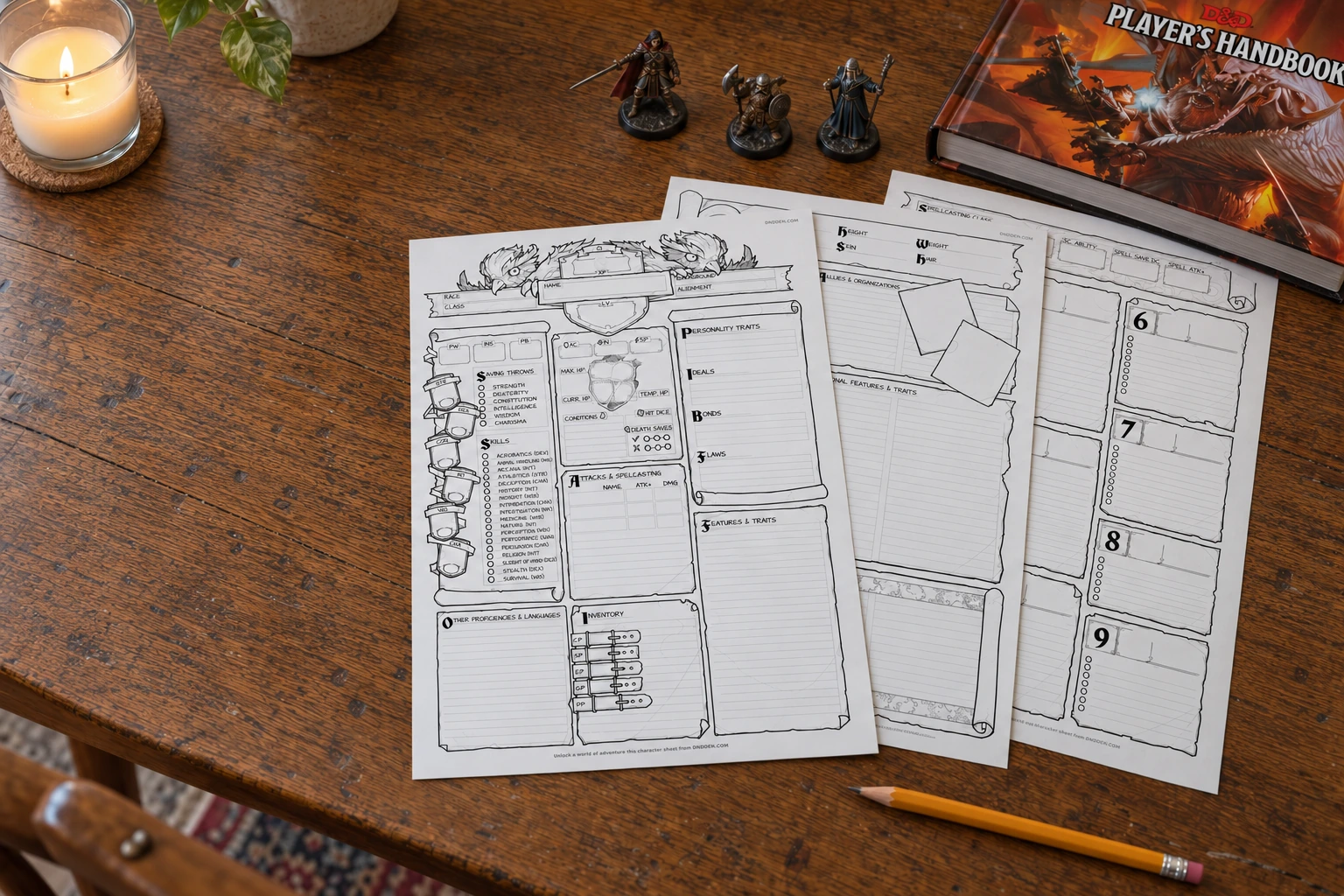
DnDDen's printable character-sheet resource is useful if you need a paper record. If you are starting from a blank sheet, use the complete character-creation walkthrough before the session. A readable set of polyhedral dice is sufficient for physical play; premium materials are a preference, not a rules requirement.
Before play begins, find five things on your sheet: Armor Class, current Hit Points, your main attack or spell, the skills you are proficient in, and abilities with limited uses. Knowing where those are is more valuable than recognizing every rulebook term.
Use the download and sheet-filling guide if you need help finding the relevant fields.
Meet the character used in the examples
Mara is a former caravan guard following a trail of missing travelers. Her party has reached an abandoned roadside tollhouse. The examples below assume she completed a Long Rest before setting out and has not yet spent any resources.
| Relevant statistic | Mara's value |
|---|---|
| Class and origin | Fighter 1; Human; Soldier |
| Strength, Dexterity, Constitution | 17 (+3), 13 (+1), 15 (+2) |
| Intelligence, Wisdom, Charisma | 10 (+0), 12 (+1), 8 (-1) |
| Proficiency Bonus | +2 |
| Armor Class and Hit Points | AC 19 with Chain Mail, Shield, and Defense; 12 HP |
| Speed and Initiative | 30 feet; +3 Initiative because of Alert |
| Useful skills | Athletics +5; Perception and Insight +3; Persuasion +1 |
| Main attack | Flail +5 to hit; 1d8 + 3 bludgeoning damage |
| Limited resources | Two Second Wind uses; one available Heroic Inspiration |
She also has Savage Attacker and the Flail's Sap mastery. Those features will matter in the combat example. The character uses the current Fighter rules, Human and Soldier entries, and relevant feats.
This is an illustrative encounter, not a published adventure or monster stat block. Its difficulties and rolls are chosen to demonstrate procedures. Your DM may set different difficulties for the actual circumstances of your game.
For another role, read the class playstyle comparison. The feat guide explains how those choices affect your character.
Understand the dice before the first roll
Dice notation describes the number and type of dice. 1d20 means one twenty-sided die. 2d6 + 3 means roll two six-sided dice, total them, and add 3 once. The number after the d is the number of faces, not a bonus.
Many important rolls use a d20. Three categories are collectively called D20 Tests:
| Test | What it resolves | Typical comparison |
|---|---|---|
| Ability check | Attempting something uncertain | Meet or exceed a Difficulty Class |
| Saving throw | Resisting a threat or effect | Meet or exceed the effect's Difficulty Class |
| Attack roll | Trying to hit a target | Meet or exceed the target's Armor Class |
Difficulty Class, abbreviated DC, is the target number for a check or saving throw. Armor Class, or AC, is the target number for an attack. A tie succeeds. Rolling damage is a separate procedure and is not a D20 Test.
Your ability modifier and any applicable proficiency are normally already included in a completed sheet's displayed bonus. If the sheet says Athletics +5, add 5 to the d20 result. Do not then add Strength and proficiency again.
For a saving-throw example, suppose a loose shutter falls toward Mara and the DM calls for a Dexterity save against an illustrative DC 12. She adds her Dexterity save bonus of +1. A roll of 11 totals 12 and succeeds. The hazard's instructions determine what that success prevents or reduces; success does not always mean taking no damage.
Advantage and disadvantage
With advantage, roll two d20s and use the higher result. With disadvantage, use the lower. Add the relevant modifier to the selected result. Multiple sources do not produce an ever-growing pile of d20s, and advantage and disadvantage cancel when both apply to the roll.
For a check with advantage, rolls of 7 and 15 with a +3 bonus produce 18. With disadvantage, the same dice produce 10. You can roll one physical d20 twice, keeping both results, if that is what you have available.
The DnDDen dice roller offers the common die types for practice. Keep track of which result you are using and add your character's modifiers yourself.
What natural 1 and natural 20 mean
A natural result means the unmodified face of the die. On an attack roll, a natural 20 hits and causes a critical hit; a natural 1 misses. An ordinary ability check does not automatically succeed on a 20 or fail on a 1 under the general rules. Death saving throws have their own special results.
That distinction matters. A high Persuasion roll does not force someone to grant an impossible request, and an excellent Athletics result cannot make an impossible physical act possible by itself. Describe the attempt; let the DM establish whether it can work.
Mara also begins with Heroic Inspiration from her Human trait after the assumed Long Rest. She can expend it to reroll one die immediately after rolling that die and must use the new result. This is a separate option from advantage. Mark it spent when used, and remember that the new roll can be worse.
Explore the tollhouse: describe an approach
The DM says: “The tollhouse door is partly open. A damaged cart stands beside it. You hear movement inside, but cannot see who is there.”
Mara's player says, “I watch the doorway while the others examine the cart. Can I tell whether the movement sounds like someone hiding or someone working?”
That statement gives the DM a clear intention and method. It is more useful than announcing “I roll Perception” without explaining what the character is paying attention to.
The DM asks for a Wisdom (Perception) check and, for this example, sets DC 12. Mara rolls 9 and adds +3, totaling 12. She succeeds and hears someone trying to hold a loose shutter still. The DM can now describe the new information and ask what the party does with it.
Notice what the roll did not establish. It did not identify the person's entire history, reveal all hidden objects in the building, or decide whether they are trustworthy. A check answers the question relevant to the attempt.
Use the environment and ask specific questions
Useful questions concern things your character could perceive: how high the window is, whether the cart can move, where the light comes from, or how far the nearest cover stands. The answers may change your plan without needing a roll.
When danger is possible, clarify the order of actions. “I open the chest while Mara watches the hallway” tells the DM who is exposed and who can notice an approaching creature. If everyone says “I search everything” simultaneously, the group loses that clarity.
You can contribute without having the highest modifier. Offer a relevant tool, remember an earlier clue, suggest a safe route, or ask another character for help. If you want a mechanical benefit from helping, the DM checks whether the rules and situation allow it. Merely announcing assistance does not guarantee advantage on every task.
Talk to people without needing acting experience
The person inside is a frightened courier. Mara can speak directly in character: “We're looking for the missing caravan. Did you see anyone pass?” She can also describe her approach: “I tell the courier we are not here to collect a toll and offer water before asking about the road.” Both are valid ways to roleplay.
Give the DM the substance of what you offer, ask, threaten, or conceal. That information helps determine the response. A Charisma check may resolve uncertainty, but it does not replace the conversation's circumstances.
In this scene, the courier willingly describes the road because the party has offered help. No roll is needed. If Mara later asks the courier to accompany the party into danger, the DM may decide a check is appropriate, or that the courier needs a concrete reassurance first.
Mara has Persuasion +1 despite Charisma -1 because she is proficient. Another party member may be more persuasive, but that does not prohibit Mara from speaking. Share the spotlight and let the person with a relevant connection contribute.
Keep player knowledge and character knowledge distinct
You may recognize a creature from a book or remember something said in a scene your character did not witness. Ask what your character knows instead of assuming all that information is available to them.
Likewise, disagreement between characters should remain comfortable for the players. If Mara distrusts the courier and another character believes them, discuss the different reasons and find a playable next step. You can express caution without taking control of someone else's character.
How to play DND combat one decision at a time
When timing becomes important in a fight, the game uses rounds and turns. A round represents roughly six seconds of activity in the world. Each participant takes a turn in an order determined by Initiative.
Initiative is a Dexterity check, modified by features that apply. Mara's Alert feat makes her bonus +3 rather than just her +1 Dexterity modifier. If she rolls 12, her Initiative is 15. The DM records the order and tells the group who acts next.
Under the revised rules, being surprised gives disadvantage on Initiative. Do not import the 2014 procedure that prevents a surprised creature from acting normally on its first turn. Refer to the current rules glossary when a specific condition or timing question arises.
Your turn has different kinds of activity
| Part of the turn | What it means | Mara's example |
|---|---|---|
| Movement | Move up to the distance currently available | Move up to 30 feet in ordinary circumstances |
| Action | Choose one action, unless a feature grants more | Attack with her Flail |
| Bonus Action | Available only when a rule grants a relevant option; at most one on the turn | Use Second Wind |
| Reaction | Respond to a specified trigger; refreshes at the start of your next turn | Make an eligible opportunity attack |
A Bonus Action is not a generic second action. Mara cannot decide to use it for any activity she would like. Second Wind specifically permits a Bonus Action; her ordinary Flail attack does not.
You can usually split your movement around your action. Moving 10 feet, making an attack, and then moving another 20 feet can be legal with Speed 30. Terrain, enemies, conditions, and other rules may change what that movement costs or triggers.
An Attack action is distinct from an individual attack roll. Mara makes one attack with that action at Fighter 1. Later features can change how many attacks the action provides. Do not assume every character attacks twice just because they carry two weapons.
Other actions can solve the real problem
Attacking is useful when the objective is defeating an enemy, but an encounter might instead involve escaping, protecting a civilian, or stopping a mechanism.
Consider Dash when you need additional movement, Disengage when you need your movement to avoid opportunity attacks, or Dodge when making yourself harder to hit serves the plan. Search, Help, Utilize, and other actions apply to their defined tasks. Read their requirements when you need them rather than memorizing the entire list immediately.
For example, if the courier is trapped behind a fallen beam, getting them out may accomplish more than chasing a fleeing attacker. Tell the DM your goal so the appropriate action or check can be resolved.
A complete example turn, with the numbers shown
Suppose a hostile intruder has entered the tollhouse. During earlier action, Mara has taken damage and now has 7 of 12 HP. She already has her Flail and Shield equipped, and the example opponent has AC 13. She has both Second Wind uses available.
Mara's plan is to move beside the courier, strike the intruder, and recover some health.
- Move 15 feet. This is within her available movement, assuming the path has no extra costs. She reaches a position where the Flail can strike the opponent.
- Make the attack. She rolls 11 on a d20 and adds +5. Her total of 16 meets or exceeds AC 13, so the attack hits.
- Roll the weapon's damage. Savage Attacker allows two sets of the weapon's damage dice once this turn. Her d8 results are 4 and 6. She selects 6 and adds Strength +3, dealing 9 bludgeoning damage.
- Apply Sap. Her selected mastery gives that opponent disadvantage on its next attack before the start of Mara's next turn.
- Use Second Wind. She spends her Bonus Action and one use. A d10 result of 3 plus Fighter level 1 restores 4 HP. Current HP becomes 11; maximum HP remains 12.
- Record the changes. One Second Wind use remains. She tells the DM that Sap is affecting the target and ends her turn.
The equipment rules provide the Flail and mastery details. Mara's +5 attack bonus already includes proficiency; damage adds Strength but not proficiency. Keeping those two rolls separate avoids a common beginner error.
If she instead wanted the Greatsword, she would need two hands for its attack. Doffing her equipped Shield takes a Utilize action, and losing it lowers this character's AC from 19 to 17. Equipment choices have consequences even when both items appear in the inventory.
What happens on someone else's turn?
Stay aware of changing positions and possible Reaction triggers. A creature you can see leaving your reach using its movement can provoke an opportunity attack, resolved immediately before it leaves. You spend your Reaction to make the permitted melee attack. Other movement circumstances can differ, and Disengage can prevent the trigger.
Once Mara uses a Reaction, she cannot use another until the start of her next turn. She does not receive a fresh Reaction at the start of every enemy's turn.
You can also use the time between turns to plan. Choose a likely action, identify the relevant modifier, and adjust if the situation changes. Listening to other players is part of making useful decisions for the whole party.
What if your character uses spells?
Mara has no spells, but a spellcaster follows the same overall rhythm: describe the intended effect, check the spell's requirements, spend the appropriate activity and resources, and resolve its instructions.
Read six details before casting: casting time, range, targets, components, duration, and effect. Determine whether it asks for an attack roll, a saving throw from a target, or neither. You do not automatically roll both an attack and a save for every spell.
Spell slots are resources spent on applicable casts; prepared spells are the options currently available under your class's rules. A cantrip is a level-0 spell and does not use a spell slot. A spell's level is not the same as character level.
In the revised rules, you can expend only one spell slot to cast a spell on a turn. That is more precise than saying “one spell per round.” Read exceptions and abilities as written rather than borrowing the older Bonus Action spell restriction. Current spellcasting rules.
Concentration means sustaining a qualifying effect. Starting another effect that requires Concentration ends the first. Taking damage can require a Constitution saving throw to maintain it, and the Incapacitated condition ends it. Mark the active effect visibly and tell the DM when it ends. A character cannot maintain several Concentration spells simply because they have spare slots.
Damage, healing, and falling to zero
When you take damage, reduce current Hit Points, leaving maximum HP unchanged unless a rule specifically affects it. If Mara at 11 HP takes 4 damage, she has 7 HP. Healing normally cannot raise current HP above the maximum.
Temporary Hit Points form a separate buffer. If an effect gives you more while you already have some, choose which amount to keep; do not add the amounts together. They are not a substitute for ordinary healing that wakes an unconscious character.
A critical hit rolls the attack's damage dice twice, then adds modifiers as usual. A simple Flail critical from Mara uses 2d8 + 3 before considering any other applicable feature. Do not double the +3 merely because the attack is critical.
When a player character reaches 0 HP without dying outright, they generally become Unconscious and face death saving throws. On the start of an applicable turn, roll a d20: 10 or higher is a success; three successes stabilize you, while three failures mean death. A natural 1 counts as two failures, and a natural 20 restores 1 HP. These are not Constitution saves with your usual Constitution bonus.
Damage at 0 HP and overwhelming damage can be especially dangerous. Ask the DM to guide this procedure the first time rather than improvising extra recovery. Stabilizing someone does not itself restore HP. The damage and healing rules explain the full process; use the current errata alongside it.
Recover, keep notes, and continue the adventure
After the danger passes, the group decides whether to investigate, speak with survivors, pursue a lead, or seek a place to rest. Completing a fight does not automatically refill resources.
A Short Rest normally requires an uninterrupted hour of suitable downtime. Eligible characters can spend Hit Dice to recover HP, adding Constitution to each die as specified. Mara has one d10 Hit Die at level 1. Spending it for recovery does not reduce her maximum HP, but it uses that recovery resource.
Different features recover differently. Mara regains one expended Second Wind use after a Short Rest. A Long Rest normally takes at least eight hours, including at least six hours of sleep and no more than two hours of light activity, unless a specific rule changes those needs. You need at least 1 HP at its start. After finishing one, you must wait at least 16 hours before starting another. Interruptions can prevent completion. Read the rest definitions and each feature's recovery instruction; do not assume every checkbox resets after an hour.
Learning how to play dnd includes maintaining this ongoing state. Note current HP, spent abilities, used ammunition, conditions, important names, and the party's next objective. You need useful reminders, not a transcript of every conversation.
For the tollhouse scene, a good note might read: “Courier saw the missing cart turn north. Broken blue seal on the message. Ask Ilen whether the seal belongs to the escort company.” That preserves the information needed for the next decision.
A practical first-session checklist
Before the session, confirm the rules and locate your main abilities. During a scene, listen to the description and state a goal with an approach. When asked to roll, identify the right bonus and announce the total clearly. After a feature changes something, update the sheet immediately.
At the end of the session, ask the DM whether the group has gained a level and what should be prepared before the next meeting. Do not assume you level up after every game or add features from a level you have not reached.
If a rule interrupts play, make the question specific: “Does my Shield prevent this two-handed attack?” is easier to resolve than “How does equipment work?” The group can agree on a ruling for the moment and consult the text afterward when necessary.
Do I have to be good at improvising?
No. You can speak normally, describe actions in third person, and take a moment to consider a choice. A few clear intentions are enough to participate. Confidence often develops after you see how the group responds to decisions.
Can I try something that is not on my sheet?
Yes. The sheet records capabilities, not every possible action. Describe the attempt and let the DM determine whether it is possible and what procedure applies. Special abilities matter, but ordinary observation, negotiation, and problem-solving matter too.
Can we use these instructions in a 2014 game?
The basic conversation and dice rhythm is similar, but specific rules differ. This guide uses revised surprise, Heroic Inspiration, Fighter features, and spellcasting procedures. Use the agreed edition's rules for a 2014 campaign instead of mixing those details casually.
You understand the essentials of how to play dnd when you can follow the scene, describe an attempt, resolve the requested roll, and track what changed. The rest can be learned through the adventures you share with the group.
Rules attribution: This work includes material from the System Reference Document 5.2.1 (“SRD 5.2.1”) by Wizards of the Coast LLC, available at https://www.dndbeyond.com/srd. The SRD 5.2.1 is licensed under the Creative Commons Attribution 4.0 International License, available at https://creativecommons.org/licenses/by/4.0/legalcode. The encounter, examples, explanations, and editorial recommendations are original adaptations and additions.
If your table uses the original rules, consult the 2014 versus 2024 comparison before transferring this procedure.