
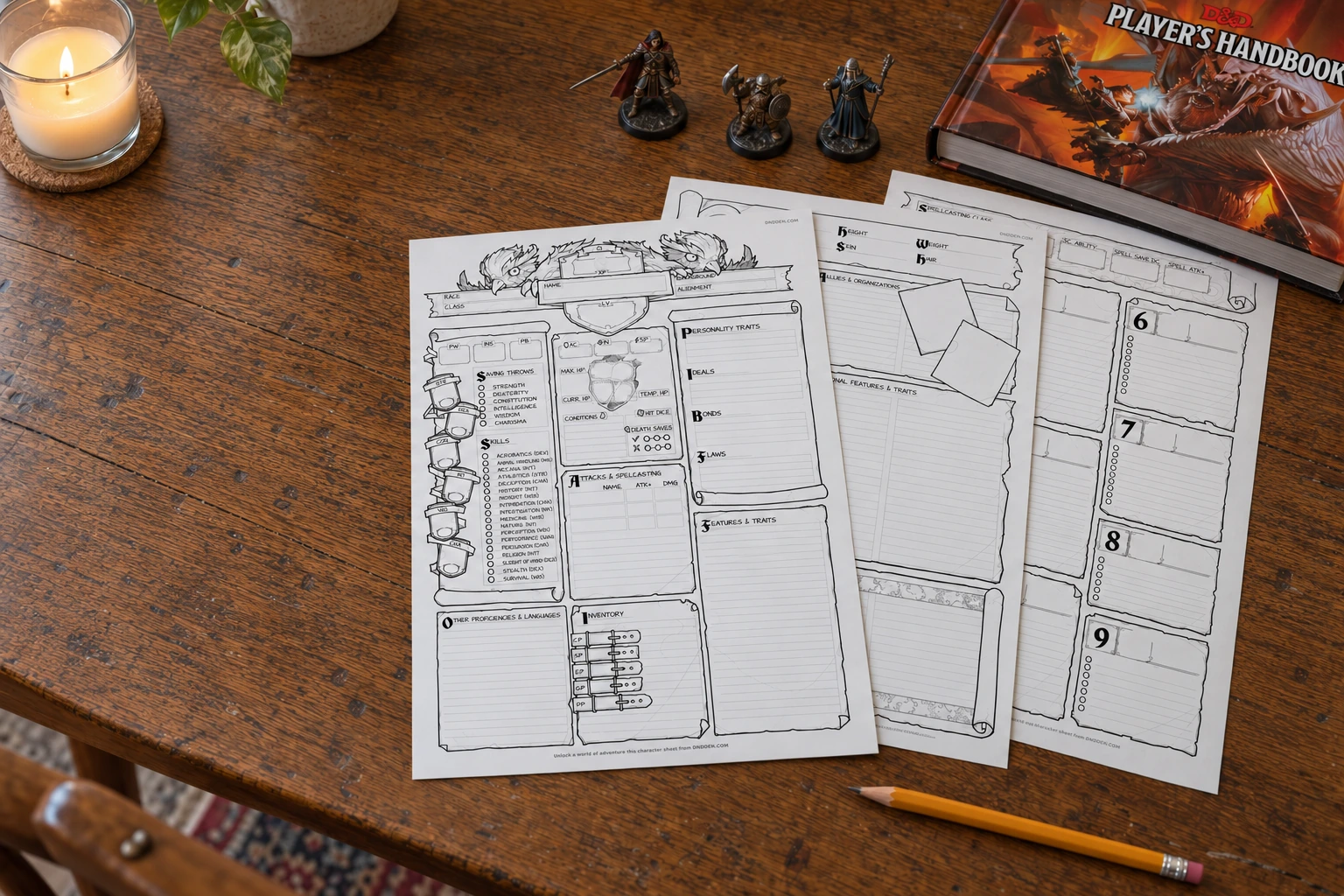
Choose your DND character sheet by the rules your group uses and how you want to record changes. A printable PDF suits pencil-and-paper play. A PDF with editable form fields lets you type into the document. An online builder can organise a character, but you still need to understand what its numbers mean.
Start with a verified download below, then use the worked example to learn the fields. The example is a level-one Human Fighter using the revised 2024 rules, also labelled 5.5e on D&D Beyond. Older 2014 differences are identified separately.
Download the right format first
| Resource | Rules/layout | Format and practical use |
|---|---|---|
| DnDDen printable PDF | Traditional 2014-style layout | Three A4 pages; print and write; no built-in form fields |
| Official 2024 printable PDF | Revised 2024 layout | Two pages; no built-in editable form fields |
| Official 2024 fillable PDF | Revised 2024 layout | Two pages containing editable PDF form fields |
| Official 2014 fillable PDF | Original 2014 layout | Three pages containing editable PDF form fields |
The DnDDen download page also explains its print format and terminology. Its traditional layout uses “Race”; revised characters use “Species” and may need additional notes for newer features. Using that layout does not turn its contents into the official revised rules.
The official files are available through D&D Beyond's sheet resources. PDF applications vary, so test typing, saving, closing, and reopening a small entry before completing a fillable file. A document that lets you add an annotation is not necessarily a document with built-in form fields.
For DnDDen's A4 sheet on US Letter paper, use the page's recommended Fit to Page setting and inspect the print preview for clipped edges. Print one test page before making several copies.
If your group has not settled on an edition, use the 2014 and 2024 rules comparison before choosing a format.
Understand what the sheet does
Your sheet is a record of decisions and a reference during play. It tells you which numbers to use, which abilities you have, and which resources remain. It does not replace the relevant class, spell, or equipment rules.
Some entries change rarely: species, background, chosen proficiencies. Others can change several times in one encounter: current hit points, expended abilities, and ammunition. Keep those two categories visually distinct so that erasing a resource does not remove its maximum.
If you have not chosen the character yet, begin with DnDDen's character-creation walkthrough. This guide focuses on putting those decisions into the correct fields and checking the resulting numbers.
Use a consistent notation for unavailable information. A dash or “not applicable” is often clearer than an invented zero. A level-one Fighter without a spellcasting feature does not need a made-up spell save DC simply because the form includes a box for it.
Fill a DND character sheet using one consistent example
Our example character is Mara Vale, a practical guard beginning her first adventure. This is an original instructional character, not an official pregenerated character or a claim about the strongest build.
Her choices are deliberately limited to the 2024 Basic Rules:
| Identity field | Entry |
|---|---|
| Name | Mara Vale |
| Class and level | Fighter 1 |
| Species | Human, Medium |
| Background | Soldier |
| Alignment | Neutral Good |
| Subclass | None yet; Fighter chooses at class level 3 |
| Languages | Common, Common Sign Language, Dwarvish |
| Rules version | Revised 2024 |
Mara chooses Perception and Insight from her class, Athletics and Intimidation from Soldier, and Persuasion from Human. Her Human Origin feat is Alert; Soldier supplies Savage Attacker. Fighter supplies the Defense Fighting Style feat. These choices follow the official origins, class, and feat rules.
For the starting snapshot, assume she has completed a Long Rest and has full resources. That assumption matters because her Human Resourceful trait grants Heroic Inspiration after a Long Rest.
Ability scores and modifiers are different entries
An ability score is the underlying number. Its modifier is the smaller number added to many rolls. Check which box on your chosen layout is meant for each; some designs make the modifier larger because it is used more often.
Mara uses the standard array, assigned before background adjustments as Strength 15, Dexterity 13, Constitution 14, Intelligence 10, Wisdom 12, and Charisma 8. Soldier permits her to raise Strength by 2 and Constitution by 1.
| Ability | Before background | Final score | Modifier |
|---|---|---|---|
| Strength | 15 | 17 | +3 |
| Dexterity | 13 | 13 | +1 |
| Constitution | 14 | 15 | +2 |
| Intelligence | 10 | 10 | +0 |
| Wisdom | 12 | 12 | +1 |
| Charisma | 8 | 8 | -1 |
To calculate a modifier, subtract 10 from the score, divide by two, and round down. For Strength 17, (17 - 10) / 2 = 3.5 becomes +3. For Charisma 8, the result is -1. Use the official table if that feels easier than calculating it.
These numbers follow the 2024 creation procedure. Do not add an older Human ability-score bonus on top. In this revised example, the background supplies the starting increases.
Proficiency connects training to the relevant roll
Mara's proficiency bonus is +2 at level one. It is not added to every number on the page. You apply it when a rule says she is proficient in the relevant check, save, attack, or other use.
A filled proficiency circle is a reminder of training, not an extra bonus beyond the total you write next to it. If Athletics is already recorded as +5, rolling the check means adding +5, not +5 and another +2.
Saving throws
Fighter gives Mara proficiency in Strength and Constitution saving throws. Her other saves use their ability modifiers because no selected feature changes them.
| Save | Proficient? | Total |
|---|---|---|
| Strength | Yes | +5 |
| Dexterity | No | +1 |
| Constitution | Yes | +4 |
| Intelligence | No | +0 |
| Wisdom | No | +1 |
| Charisma | No | -1 |
For Strength, that is +3 from the ability and +2 from proficiency. For Constitution, +2 and +2 make +4. Mark only those two proficiency circles.
Skills
Here is Mara's full skill list. The table assumes the usual ability associated with each skill and no temporary bonuses.
| Skill | Total | Proficient? |
|---|---|---|
| Acrobatics | +1 | No |
| Animal Handling | +1 | No |
| Arcana | +0 | No |
| Athletics | +5 | Yes |
| Deception | -1 | No |
| History | +0 | No |
| Insight | +3 | Yes |
| Intimidation | +1 | Yes |
| Investigation | +0 | No |
| Medicine | +1 | No |
| Nature | +0 | No |
| Perception | +3 | Yes |
| Performance | -1 | No |
| Persuasion | +1 | Yes |
| Religion | +0 | No |
| Sleight of Hand | +1 | No |
| Stealth | +1 | No |
| Survival | +1 | No |
Notice that proficiency can offset a negative ability modifier: Mara's Persuasion is -1 + 2 = +1. She can still attempt many untrained checks; the blank circle does not generally prohibit trying.
Write a separate reminder that her chain mail imposes disadvantage on Stealth. The numerical modifier remains +1. A situational instruction belongs beside the total, not inside an unexplained replacement number.
Record the numbers you need quickly
These are the values Mara wants visible during a session:
| Field | Starting entry | Explanation |
|---|---|---|
| Proficiency bonus | +2 | Level-one bonus |
| Initiative | +3 | Dexterity +1, plus +2 from Alert |
| Speed | 30 feet | Human walking speed |
| Passive Perception | 13 | 10 plus Perception +3 |
| Maximum hit points | 12 | Fighter starting 10 plus Constitution +2 |
| Current hit points | 12 | Full health for this snapshot |
| Temporary hit points | 0 | None supplied in this snapshot |
| Hit Dice | 1d10, unspent | One Fighter level |
| Armor Class with shield | 19 | Chain mail 16, shield +2, Defense +1 |
| Armor Class without shield | 17 | Chain mail 16, Defense +1 |
Armor Class, or AC, is the number an attacker usually needs to meet or exceed to hit. Hit points describe how much damage you can currently withstand. Losing hit points does not normally subtract the same amount from your AC.
Chain mail uses its listed AC rather than adding Mara's Dexterity modifier. Her Strength meets its requirement, so the armor does not reduce her Speed for insufficient Strength. The armor, shield, and weapon properties come from the 2024 equipment rules.
Maximum, current, and temporary hit points
Keep these entries separate. If Mara takes 5 damage while at 12 current hit points, current HP becomes 7 and maximum HP stays 12. If she then regains 4 HP, current HP becomes 11.
Temporary hit points are a separate buffer. They are not added to maximum HP and are not ordinary healing. If she has 5 temporary HP and receives a new amount of 8, she chooses which amount to keep instead of adding them into 13. The rules glossary explains their interaction with damage and healing.
For Hit Dice, record both the total available pool and how many are spent. “1d10” is the die type and starting pool, not a command to roll it whenever she is injured. Its use depends on the relevant rest or feature rule.
Death-saving-throw markers
Leave the success and failure markers blank while Mara is healthy. They record outcomes when the rules call for death saving throws; they are not extra hit points. A death saving throw is separate from the Constitution saving throw listed above, so do not automatically add her +4 Constitution-save bonus. If she reaches 0 HP, follow the applicable rules with the DM and use those markers to track the resulting successes and failures.
Fill the attack section with usable instructions
An attack entry should tell you what to roll to hit and what to roll for damage. Those are different expressions. It also helps to include damage type, range where relevant, and a short reminder about any selected mastery.
| Weapon | Attack bonus | Damage | Useful note |
|---|---|---|---|
| Flail | +5 | 1d8 + 3 bludgeoning | One hand; selected mastery: Sap |
| Greatsword | +5 | 2d6 + 3 slashing | Two hands; selected mastery: Graze |
| Javelin | +5 | 1d6 + 3 piercing | Thrown range 30/120 feet; selected mastery: Slow |
| Shortbow | +3 | 1d6 + 1 piercing | Range 80/320 feet; requires two hands |
| Spear | +5 | 1d6 + 3 piercing | Versatile: 1d8 + 3 with two hands; thrown 20/60 |
Mara's Strength weapon attack bonus is +3 ability plus +2 proficiency, for +5. Her shortbow uses Dexterity, so +1 plus +2 makes +3. Weapon proficiency does not normally add another +2 to damage.
Her selected mastery weapons are Flail, Greatsword, and Javelin. Owning another weapon does not automatically unlock its mastery. Put the full mastery reminders in a notes area if the attack box is small.
The normal defensive setup is flail and shield. She cannot attack with the two-handed greatsword while using that shield. In the revised rules, doffing the shield takes a Utilize action; do not erase the shield bonus and treat the equipment change as free.
For now, write “AC 19 with shield; AC 17 without” prominently. That avoids remembering only the most favourable number while using incompatible equipment.
Track features and resources separately
Copy enough information to use a feature, then keep a source reference for its full wording. A name alone may not remind you of its action cost or limitation.
Mara's useful feature notes include:
- Second Wind: Bonus Action; regain 1d10 + 1 HP at this level. Two uses. Regain one expended use after a Short Rest and all after a Long Rest.
- Savage Attacker: once per turn after a weapon hit, roll that weapon's damage dice twice and choose one whole set of results. Add the normal modifier once.
- Alert: proficiency is already included in the +3 Initiative entry. Its initiative-swap option needs the feat's conditions checked.
- Defense: the +1 AC is already included while wearing armor.
- Human Resourceful: Heroic Inspiration after a Long Rest.
- Human Skillful and Versatile: the chosen skill and extra Origin feat are already reflected elsewhere.
The DND character sheet should make remaining resources obvious. Draw two small boxes for Second Wind and use a consistent convention, such as empty means available and crossed means spent. Write the recovery rule next to them.
Heroic Inspiration is a separate resource, not a permanent modifier. In the revised rules it permits an immediate reroll of one die and requires using the new result. This differs from 2014 Inspiration's use, so label it correctly on a traditional layout.
Do not add future class features early. Mara has no Action Surge at Fighter 1 and no Extra Attack. Those arrive at later class levels.
Use the feat-selection explanation to distinguish a feature choice from its place on the sheet.
Equipment, money, and other proficiencies
Mara receives the chosen starting package from both Fighter and Soldier. Do not select an equipment package and then also add the alternative starting-gold option from the same choice.
Her Fighter package includes chain mail, a greatsword, a flail, eight javelins, a Dungeoneer's Pack, and 4 GP. Soldier adds a spear, shortbow, twenty arrows, a Dice Set, Healer's Kit, quiver, traveler's clothes, and 14 GP.
She begins with 18 GP before buying a shield for 10 GP, leaving 8 GP. Put the shield in equipment and the remaining 8 in the gold field. Keep the spent amount in a short setup note if you want an audit trail.
Record her Dice Set tool proficiency separately from merely owning the item. Also record proficiency with Simple and Martial weapons, and training with Light, Medium, and Heavy armor and Shields.
When play begins, track things that can be used up, including arrows and kit uses where relevant. Mark what she is carrying and what is stored elsewhere. If the campaign tracks carrying capacity, use the equipment weights and the group's agreed procedure rather than guessing from the number of inventory lines.
What belongs on the spell page?
For this Fighter example, mark spellcasting as not applicable. Mara's selected level-one features do not grant spells. Leave the page unused or reserve it for general notes; do not fabricate a spellcasting ability, attack bonus, or save DC.
For a character who does cast spells, distinguish these entries:
- Spellcasting ability: the ability specified by the class or feature.
- Spell attack bonus: normally the relevant ability modifier plus proficiency.
- Spell save DC: normally 8 plus that ability modifier and proficiency.
- Spells available or prepared: the spells the character can currently use under the relevant feature.
- Spell slots: a resource used to cast eligible spells, tracked separately from the spell list.
As a separate arithmetic illustration, an applicable ability modifier of +3 and proficiency of +2 produce a spell attack bonus of +5 and a save DC of 13. This does not give Mara spellcasting; it explains how a qualifying spellcaster would calculate the fields.
For each spell you actually have, note its action, range, concentration requirement, and any important material requirement. A checked “prepared” box does not mean the spell has already been cast, and an expended slot does not erase it from the prepared list. Consult the relevant class and spell text for exceptions.
Use the sheet through a sample turn
Take Mara's flail-and-shield setup, with AC 19 and current HP temporarily reduced to 7 of 12. Assume both Second Wind uses are available. A practice opponent has AC 13; this is an illustrative target, not a published monster.
- Choose the attack. The flail line shows +5 to hit. A d20 result of 11 produces 16, which hits AC 13.
- Resolve weapon damage. If using Savage Attacker this turn, roll the weapon die twice. Results of 4 and 6 let her choose 6, then add Strength +3 for 9 bludgeoning damage.
- Apply the selected mastery. Sap gives the target disadvantage on its next attack roll before Mara's next turn starts.
- Use a resource if desired. Second Wind is a Bonus Action. A d10 result of 3 plus Fighter level 1 restores 4 HP, taking her from 7 to 11.
- Update the record. Cross off one Second Wind use. Current HP is 11, maximum remains 12, and AC remains 19.
Nothing in that sequence requires rewriting her ability scores or attack bonus. The changed information is primarily resource state. You can practise finding the necessary dice with DnDDen's online roller, while applying the feature instructions yourself.
The beginner session tutorial continues Mara’s adventure. If you are choosing a different role, compare the twelve core character classes.
Keep 2014 and 2024 entries separate
A traditional layout can still hold revised character information, but familiar labels can hide changed mechanics. Add “2024 rules” beside the character name and use notes for features the form does not name.
For a 2014 character, calculate from the chosen 2014 rules instead. Do not copy Mara's background ability adjustments, Human Origin feat, revised Second Wind resources, Weapon Mastery, or Heroic Inspiration onto an older character automatically.
The official Player's Handbook errata page is the place to check current corrections. A saved PDF sheet does not update its handwritten rules reminders when an underlying feature is corrected.
Fix common sheet problems before game night
An unexpectedly large bonus: check whether proficiency was added twice. Trace the number back to its ability modifier, training, and any real feature bonus.
AC changing mysteriously: write equipment conditions explicitly. Heavy armor, a shield, and a fighting style do different jobs, and incompatible equipment cannot all contribute at once.
A resource with no maximum: add both available uses and the recovery rule. “Second Wind used” is less useful than a two-box tracker with rest notes.
A PDF that will not retain typing: save a local copy, use a compatible PDF application, and test reopening it. If you are using a printable file, switch to an actual fillable version or use annotations knowingly.
Too much text in a small box: keep the short reminder on the front and put fuller explanations in a notes page. Preserve action costs, limits, and source references.
A final review checklist
- Confirm the rules version and starting level with the DM.
- Distinguish ability scores from their modifiers.
- Mark only the proficiencies the character actually has.
- Recalculate AC, HP, Initiative, and commonly used attacks.
- State any equipment conditions beside the relevant number.
- Separate current resources from maximum resources.
- Leave inapplicable spell or subclass fields clearly unfilled.
- Record money after purchases and the equipment actually selected.
- Save a backup or keep a dated copy after major changes.
Frequently asked questions
Does a fillable PDF calculate everything automatically?
Not necessarily. Editable fields establish that you can enter information; they do not guarantee a full character-building calculator. Check the particular file's behaviour and verify the numbers yourself.
Can I use pencil on a printed sheet?
Yes. Pencil is particularly convenient for values that change frequently. Keep enduring choices readable and use a consistent convention for tracking spent resources.
Do I need to complete every box?
No. Fill the fields that apply to the character and campaign. A noncaster may have no spell page, and a character below the relevant class level may have no subclass yet.
A useful DND character sheet makes the next decision easier. Choose the correct format, understand how the numbers were obtained, and keep the information that changes during play easy to update.
Rules attribution: This work includes material from the System Reference Document 5.2.1 (“SRD 5.2.1”) by Wizards of the Coast LLC, available at https://www.dndbeyond.com/srd. The SRD 5.2.1 is licensed under the Creative Commons Attribution 4.0 International License, available at https://creativecommons.org/licenses/by/4.0/legalcode. See the licensed reference PDF. The character, worked calculations, and instructions are original adaptations and additions.