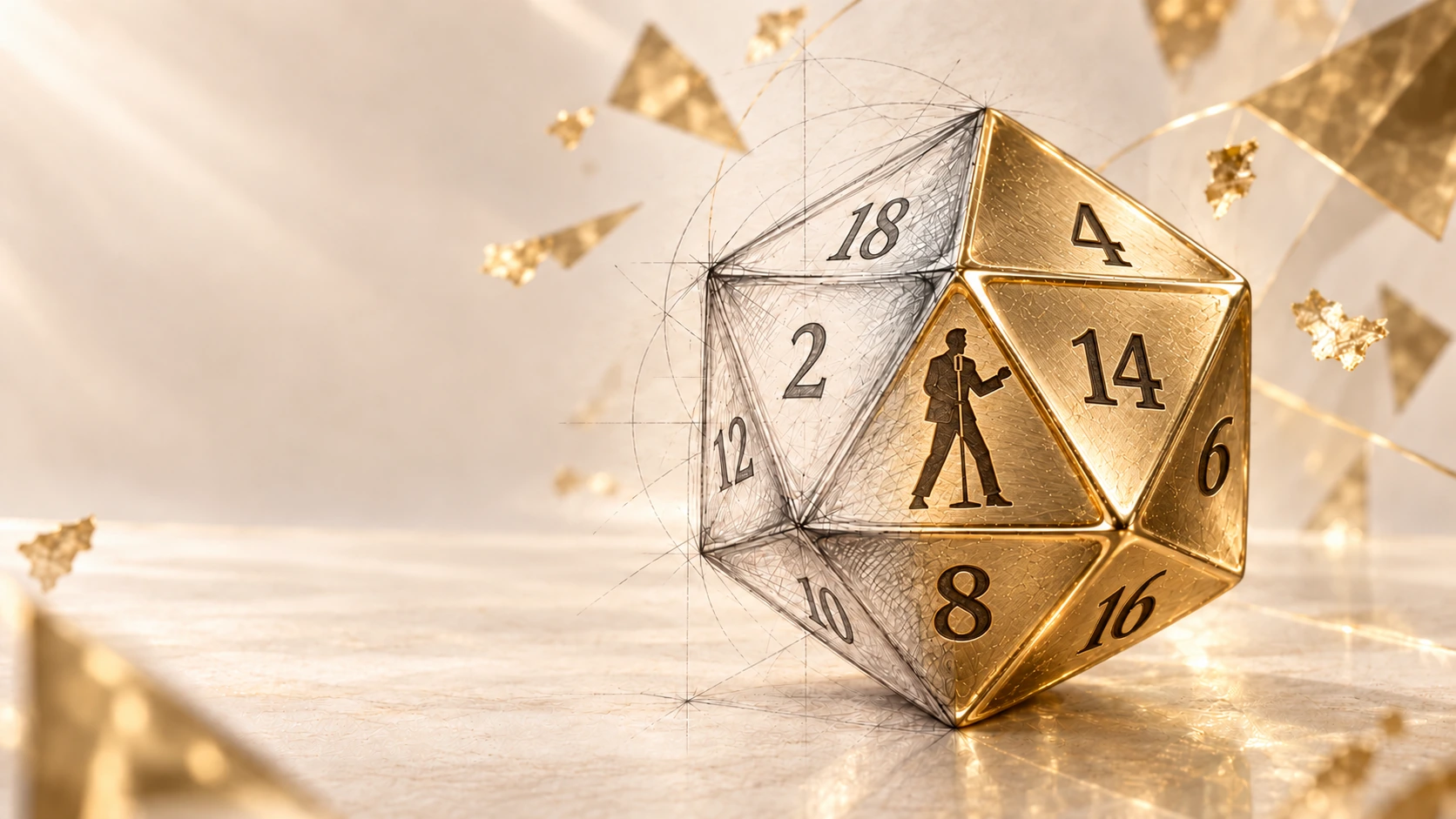
The practical answer to “how many dice do you need for DND?” is one complete seven-piece set to start. That gives you a d4, d6, d8, d10, d12, d20, and a second ten-sided die marked in tens. A second d20 is a convenient first extra. You can add duplicate damage dice once you know what your character regularly rolls.
You do not need a separate physical die for every result in a large roll. Reusing one die and recording each result works. You can also share dice or use a digital roller if that suits your group.
The physical dice types are the same for 2014 D&D and the revised 2024 rules. Individual class features and spells may differ, so use your campaign's chosen rules when determining which dice to roll.
The seven pieces in a standard set
The letter “d” identifies a die, and the number after it tells you how many sides it has. A d6 is a six-sided die. A d20 has twenty sides.
Retailers commonly package these dice as a seven-piece polyhedral set. “Polyhedral” simply refers to their many-faced shapes. Die Hard Dice's set-contents explanation lists the conventional seven pieces; the official 2014 rules explain their notation.
| Die | Conventional appearance | What to recognise |
|---|---|---|
| d4 | Small triangular pyramid | Produces a result from 1 to 4 |
| d6 | Familiar cube | Produces a result from 1 to 6 |
| d8 | Two pyramids joined at their bases | Produces a result from 1 to 8 |
| d10 | Ten-sided shape with pointed ends | Produces 1 to 10 when rolled by itself |
| Percentile d10 | Similar to the d10, marked 00, 10, 20, and so on | Supplies the tens portion of a percentile result |
| d12 | Twelve faces, conventionally pentagons | Produces a result from 1 to 12 |
| d20 | Twenty triangular faces | Produces a result from 1 to 20 |
Some novelty designs use different shapes, so check their numbering and instructions. For a beginner, an ordinary clearly numbered set makes it easier to recognise the die named by the DM, who runs the adventure and adjudicates the rules.
When shopping, read the actual contents. A single impressive d20 or a pack of six-sided dice can be useful, but neither is necessarily a complete starting set. DnDDen's dice collection lets you compare available sets and their stated contents.
Read a dice expression in three parts
A notation such as 3d6 + 2 tells you three things:
- 3: produce three separate die results.
- d6: use a six-sided die for each result.
- + 2: add two to the combined total.
Suppose the results are 2, 5, and 6. Add those first: 2 + 5 + 6 = 13. Then add the modifier once: 13 + 2 = 15.
You can obtain those results by rolling three physical d6s together, one physical d6 three times, or another combination that produces three separate rolls. Write down results if you are reusing the same die and might lose track.
Do not roll once and multiply that result by three. That creates a different distribution of possible outcomes. For example, multiplying one d6 result by three can only produce 3, 6, 9, 12, 15, or 18 before modifiers. Adding three separately rolled d6s can also produce totals such as 4, 7, and 14.
The same reading method applies to other expressions. In 2d8 + 3, two d8 results of 4 and 7 total 11, then the modifier makes 14. In 1d12, you need only one result and no extra modifier unless another relevant rule supplies one.
What each die does at the table
The d20 handles checks, attacks, and saves
You will reach for the d20 when the game calls for an ability check, attack roll, or saving throw. The revised rules group these under the name D20 Tests. Typically, you add the relevant modifier to the result and compare the total with a target number.
An ability check might resolve an uncertain attempt to climb or recall information. An attack roll determines whether an attack hits. A saving throw can represent resisting a harmful effect. The official playing rules explain these uses.
Your character sheet should supply the relevant numbers. Do not automatically add your proficiency bonus again if it is already included in the listed modifier.
The other dice supply the amounts a rule specifies
Weapons, spells, healing, and other features can call for d4s, d6s, d8s, d10s, or d12s. Read the actual expression rather than assuming a class always uses one particular die.
A character may use one shape for a weapon and another for a spell. A new feature or a change of equipment can alter what is useful. You still benefit from having the full selection available for an unexpected roll.
If you are building your character, DnDDen's character-creation guide can help you organise the choices. Keep the rules edition visible on the sheet so an old spell or equipment note does not become your shopping list by mistake.
A d4 may need a different reading habit
Pyramid-shaped d4s do not have a single flat upper face like a cube. Their numbering layouts can indicate the result around the top point or along the bottom edges. Establish which layout your set uses before the first important roll.
If several numbers appear on each face, do not add them together. Look for the consistent result indicated by the design, or ask the seller or another player to demonstrate it. Unusual shapes may have their own reading instructions.
Advantage and disadvantage: useful reasons for a second d20
With advantage, produce two d20 results and use the higher one. With disadvantage, use the lower one. Apply the relevant modifier to the chosen result. You can reuse one physical die if necessary.
For example, suppose your modifier is +4 and the two results are 6 and 15:
- With advantage, use 15 + 4 = 19.
- With disadvantage, use 6 + 4 = 10.
You are not adding the two die results together. Two reasons for advantage also do not normally mean rolling three d20s. The core advantage/disadvantage procedure is explained in the 2014 ability-score rules and retained in the revised rules.
A second d20 makes the comparison immediate and keeps both results visible. For that reason, one complete seven-piece set plus one extra d20 is a practical eight-piece starting kit. Buying a second complete set is another option, but it gives you duplicates of everything whether you need them or not.
Percentile dice: how two d10s become a d100
A percentile roll generates a result from 1 to 100. You do not need a hundred-sided object. Use the ordinary d10 for the units and the die marked in tens for the other part.
Combine their digits using the following convention. The one special case is 00 and 0, which means 100. This is the convention in the official percentile-dice explanation.
| Tens die | Units die | Result |
|---|---|---|
| 40 | 7 | 47 |
| 00 | 8 | 8 |
| 30 | 0 | 30 |
| 90 | 9 | 99 |
| 00 | 0 | 100 |
Notice that the units die's 0 means a zero units digit here. You do not turn 30 and 0 into 40.
By contrast, an ordinary d10 marked 0 through 9 uses 0 as 10 when generating its own 1-to-10 result. Keep those two uses separate: a standalone d10 roll and one digit of a percentile pair are different readings.
You can also use two ordinary d10s, provided you designate which supplies tens and which supplies units before rolling. With only one d10, roll it twice in an agreed order and record the digits. Do not choose their roles after seeing the results.
How many dice do you need for DND once you have a character?
Look at the rolls you make regularly. That gives you a more useful answer than a universal list of extras for every class.
Create a small inventory like this hypothetical example:
| Regular instruction | Simultaneous dice needed | What one basic set already supplies |
|---|---|---|
| 1d20 plus a modifier | One d20 | Enough |
| Advantage on that roll | Two d20s | Reuse the d20 or add one extra |
| 2d6 plus a modifier | Two d6s | Reuse the d6 or add one extra |
| 1d8 plus a modifier | One d8 | Enough |
| Occasional percentile table | Two d10s in assigned roles | Ordinary d10 plus tens die |
This is a notation example, not a complete legal class build. Replace its expressions with the actual ones on your own sheet.
If you already own a standard set, this example suggests only two convenient additions: another d20 and another d6. You do not need to buy a second full set just to achieve that arrangement.
For a Fighter, keep repeated attacks and weapon pools organised. The set-selection checklist helps you choose readable dice for your actual equipment and rules version.
When you know which pieces you need, the set-buying checklist helps compare the actual products.
Large damage rolls do not require a large collection
Suppose a rule asks for 8d6. You could roll eight d6s together, roll four twice, or roll one eight times. In every case, you need eight separately generated results.
Imagine those results are 1, 2, 3, 4, 4, 5, 5, and 6. Grouping them can help: 1 + 2 + 3 + 4 = 10, while 4 + 5 + 5 + 6 = 20. The combined total is 30.
When repeating a smaller group, write the subtotal before rolling again. That prevents you from relying on memory while the table is talking. If you use different colours for separate damage types or effects, assign the roles before the roll and keep the totals separate where the rules require it.
At this point, “how many dice do you need for DND?” becomes a question about speed and comfort. If an eight-result pool appears constantly, owning enough matching dice may improve your routine. If it appears once in a long while, borrowing or rerolling may be entirely satisfactory.
Critical hits can temporarily increase the pool
Under the ordinary critical-hit rule in both versions discussed here, you roll the attack's damage dice twice and add the usual relevant modifiers. You can roll the additional dice together or reuse your existing pieces. Official 2014 critical-hit rule.
For a simplified attack that normally deals 1d8 + 3, a critical hit therefore calls for 2d8 + 3. If those d8 results are 5 and 7, the damage is 15. The +3 is not doubled by this rule.
This example assumes no additional damage features or exceptions. Follow the exact rules for the attack your character makes, and distinguish official rules from a table's house procedure. A critical hit does not require you to own a permanent duplicate of every die it might involve.
Do Dungeon Masters need more dice?
A DM can begin with the same basic set, but may appreciate extras when resolving several creatures or larger damage pools. Preparation tells them which shapes are likely to be useful.
The goal is readable, organised results. A pile of twenty assorted sets can be less convenient than a modest collection arranged by shape. If several rolls are made together, the DM should decide which result belongs to which creature or effect before seeing them.
DnDDen's dice quantities and organisation guide offers collection and organisation ideas. A roomier tray, clear labels, or separating active dice from counters may help as much as increasing the quantity.
Sharing dice and using an online roller
Ask the group what it already provides. A newcomer may be able to borrow a set for the first session and discover which size, style, and extras they enjoy before buying anything.
Online play may use a virtual tabletop's roller or another agreed tool. If your group is happy with that approach, you do not need physical dice to generate results. Make sure everyone knows where rolls should appear and how the table handles any mistakes.
You can explore the available shapes in DnDDen's online dice roller. When practising, distinguish a tool's displayed total from instructions such as taking the highest result. Do not assume every roller automatically applies advantage, modifiers, or your character's features.
Keep the actual expressions close to your notes. A printed character sheet can help you record commonly used rolls and modifiers in one place, even if you use a separate device to generate the numbers.
Practise before the first session
Try these short exercises with whatever dice you have. You can supply the listed results manually when learning the arithmetic.
- 2d6 + 4, showing 3 and 5: 3 + 5 + 4 = 12.
- 1d20 + 2, showing 11: 11 + 2 = 13.
- Advantage, showing 8 and 14, modifier +3: choose 14, then add 3 for 17.
- Percentile dice showing 60 and 2: read 62.
- Percentile dice showing 00 and 0: read 100.
The useful habit is to identify the instruction first, then choose the dice, then calculate the result. Speed follows familiarity; you do not need to memorise every shape immediately.
Continue with the first-session walkthrough to put those rolls into a tabletop scene.
Frequently asked questions
Is six dice enough if I am missing the percentile die?
Yes, if you have the six standard die types and are willing to reuse the d10 for percentile rolls when needed. Assign the first and second rolls to tens and units before rolling. The seventh piece makes that procedure more convenient.
Can I use ordinary board-game dice?
An ordinary numbered or pipped six-sided die can supply a d6 result. You will still need a way to generate the other requested die types, such as borrowing the relevant pieces or using an agreed digital roller.
Do different classes require different physical sets?
The same conventional set is a useful base for any class. What changes is the convenience of particular duplicates. Buy those according to the spells, weapons, and features you actually use.
Should I buy extras before choosing my character?
There is little need beyond a convenient second d20. Start with the basic shapes, learn which rolls you repeat, and expand from experience.
Your answer to “how many dice do you need for DND?” can stay simple: start with one complete set, add a second d20 if useful, and buy further duplicates when they solve a real problem at your table.