
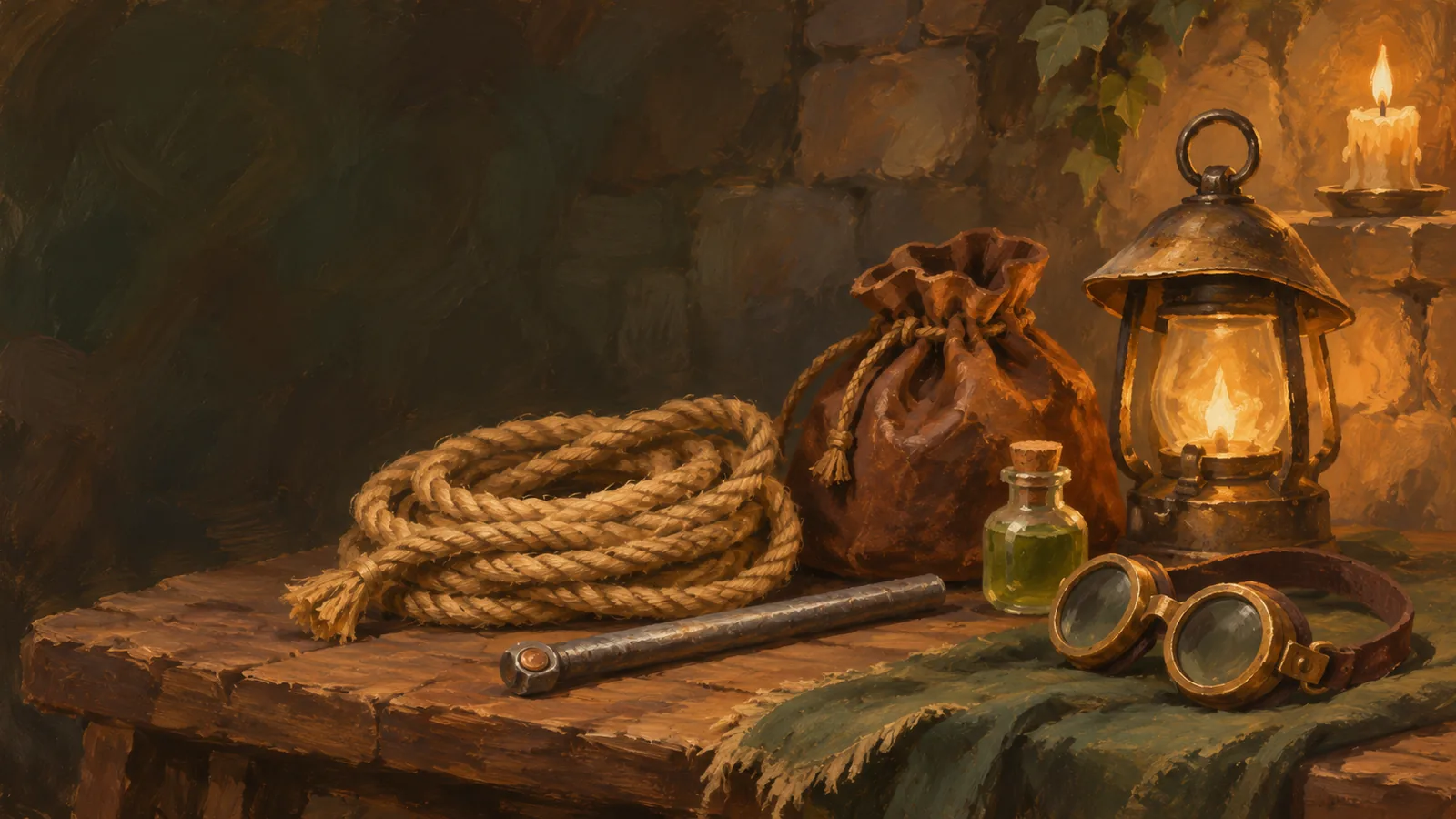
The most memorable early treasure is often something a party can build a plan around: a rope that climbs ahead, a lantern that exposes an invisible object, or a hat that opens the wrong door in exactly the right disguise. These ten D&D magic items for low-level parties reward curiosity, teamwork and a little invention.
My first pick for a shared permanent reward is the Rope of Climbing. For a smaller, one-use reward, try a Potion of Climbing; for a party struggling with darkness, consider Goggles of Night. The best choice depends on the adventures you actually run.
Rules checked 3 November 2026. This guide uses the revised 2024 fifth-edition rules, also labelled 5.5e on D&D Beyond, and official items available in the 2024 Free Rules magic item collection. Suitability for levels 1–4 is our editorial judgment, not an official promise that every item fits every campaign. If your group uses older books, our 2014 versus 2024 D&D rules comparison will help you keep editions straight.
Compare the ten beginner-party treasure picks
When choosing D&D magic items for low-level parties, I look for a clear job, an understandable limit and opportunities for several players to contribute. These common and uncommon rewards favour exploration, investigation and social play over extra damage.
| Rank and item | Rarity | Attunement | Best use |
|---|---|---|---|
| #10 · Potion of Climbing | Common | No | A difficult climb for one adventurer |
| #9 · Eyes of Minute Seeing | Uncommon | No | Close investigation of small clues |
| #8 · Lantern of Revealing | Uncommon | No | Finding invisible creatures or objects |
| #7 · Helm of Comprehending Languages | Uncommon | No | Understanding unfamiliar language |
| #6 · Hat of Disguise | Uncommon | Yes | Infiltration and social misdirection |
| #5 · Goggles of Night | Uncommon | No | Helping a character see in darkness |
| #4 · Wand of Secrets | Uncommon | No | Locating the nearest hidden door or trap |
| #3 · Bag of Holding | Uncommon | No | Carrying supplies and recovered treasure |
| #2 · Immovable Rod | Uncommon | No | Making an anchor or support |
| #1 · Rope of Climbing | Uncommon | No | Creating a climbing route for the group |
Only the Hat of Disguise requires attunement. That makes most of this list easy to share, although someone still needs to carry, wear or activate an item as its description requires. The ranking reflects versatility at the table, rather than a rulebook power rating.
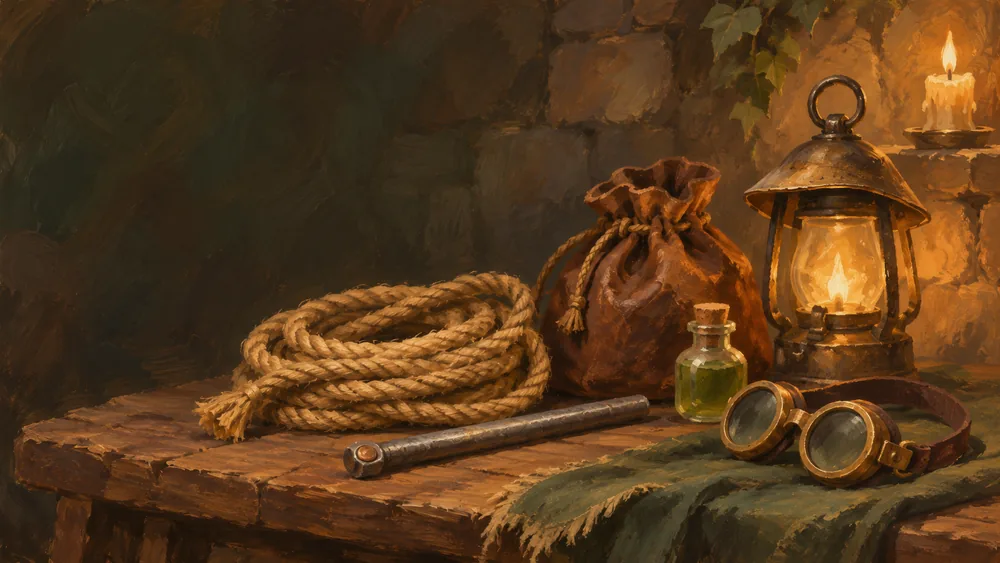
#10. Potion of Climbing: A temporary answer to a difficult route
Common potion · No attunement · Lasts 1 hour
A Potion of Climbing gives the drinker a Climb Speed equal to their Speed and Advantage on Strength (Athletics) checks made to climb for one hour. Under the revised potion rules, drinking it or administering it to another creature takes a Bonus Action. See the official Potion of Climbing rules.
Try it: a watchtower’s stairs have collapsed. One adventurer drinks the potion, climbs to a surviving window and secures an ordinary rope for the rest of the party. Everyone benefits from a reward used by one character.
Limit: this is a consumable, not the Spider Climb spell. It does not promise hands-free movement or make every surface climbable. Let the player describe a route before deciding whether a check is needed.
#9. Eyes of Minute Seeing: Give the investigator a useful tool
Uncommon wondrous item · No attunement
These crystal lenses grant Darkvision within 1 foot and Advantage on Intelligence (Investigation) checks to examine something within that same distance. The narrow range matters: Eyes of Minute Seeing are for close inspection, not scanning a dungeon corridor.
Try it: the party suspects a merchant’s ledger was altered. The lenses help their investigator examine cramped handwriting, scraped parchment or a changed total. The clue can then lead to a conversation, a pursuit or another discovery.
Limit: the lenses do not automatically identify a forgery or detect every trap. They improve an appropriate check; they do not replace the investigation. Our beginner’s guide to playing D&D explains how a player’s description and the DM’s ruling work together.
#8. Lantern of Revealing: Make the unseen part of the scene
Uncommon wondrous item · No attunement
A lit Lantern of Revealing makes invisible creatures and objects visible inside its 30-foot radius of Bright Light. One pint of oil fuels six hours of light, with Dim Light extending another 30 feet.
Try it: the party knows a smuggler hid a lockbox in an apparently empty room. Sweeping the lantern’s bright light across shelves and alcoves reveals the invisible box while leaving the questions of ownership, traps and access unresolved.
Limit: the outer Dim Light does not reveal invisible things. Lowering the hood leaves only Dim Light in a 5-foot radius, so it also removes the revealing area. This lantern is not a universal answer to illusions.
#7. Helm of Comprehending Languages: Let ancient clues be read
Uncommon wondrous item · No attunement
While wearing the Helm of Comprehending Languages, you can cast Comprehend Languages with a Magic action. For one hour, the spell lets you understand the literal meaning of language you hear or see signed. You can also understand writing while touching its surface, taking about a minute per page.
Try it: a sealed shrine bears a warning in an unfamiliar script. The helm makes the warning accessible, but the players still decide whether to trust it and what to do next.
Limit: understanding is not speaking. The spell does not teach a language or decode a cipher, hidden message or non-language symbol. It helps the party reach a decision without making that decision for them.
#6. Hat of Disguise: Give a social plan a starting point
Uncommon wondrous item · Requires attunement
An attuned wearer can use the Hat of Disguise to cast Disguise Self with a Magic action. The illusion changes apparent appearance, including clothing and carried belongings. It lasts up to one hour and ends early if the hat comes off.
Try it: an adventurer appears dressed as a warehouse clerk while their companions prepare a plausible delivery story. The hat supplies the look; the group supplies the timing, paperwork and conversation.
Limit: the change is visual, not physical. Touch can expose a mismatch, and a creature can examine the disguise with a Study action and a successful Intelligence (Investigation) check against the spell save DC. Looking like a guard does not supply their password or memories.
#5. Goggles of Night: Help the party stay together underground
Uncommon wondrous item · No attunement
Goggles of Night grant Darkvision out to 60 feet. If the wearer already has Darkvision, they extend its range by 60 feet. There are no charges to manage or separate activation required.
Try it: the human scout can finally accompany companions through an unlit passage without being the only person unable to see. Among D&D magic items for low-level parties, this is a particularly useful pick when a single character’s missing sense keeps splitting the group.
Limit: Darkvision treats darkness as Dim Light, with colours reduced to shades of grey; it is not perfect sight. It also cannot see through the Darkness spell. Keep a light source for colour-dependent clues and careful searches.
#4. Wand of Secrets: Point toward the next interesting problem
Uncommon wand · No attunement · 3 charges
While holding a Wand of Secrets, you can spend one charge and take a Magic action to make it pulse and point toward the nearest secret door or trap within 60 feet. It regains 1d3 expended charges at dawn each day.
Try it: the party has searched a dead-end chamber without finding a route onward. The wand points toward a concealed doorway, turning “Where do we go?” into “How does this open?”
Limit: it locates the nearest qualifying feature; it does not explain a mechanism, disarm a trap or open a door. Preserve something worthwhile for the party to investigate after the wand points.
#3. Bag of Holding: Make supplies and rescued treasure manageable
Uncommon wondrous item · No attunement
The revised Bag of Holding carries up to 500 pounds, provided the contents fit within 64 cubic feet. The bag itself weighs 5 pounds, regardless of what is inside. Retrieving something takes a Utilize action.
Try it: a flooded village archive is full of records that matter more than coins. The party can rescue books and family histories instead of abandoning everything their backpacks cannot hold.
Limit: overloading, piercing or tearing the bag destroys it and scatters its contents on the Astral Plane. Nesting it inside an extradimensional space created by a similar magic item is dangerous, too. Keep the full description available and record shared contents on a character sheet or party inventory.
#2. Immovable Rod: Put a fixed point into a flexible plan
Uncommon rod · No attunement
Pressing an Immovable Rod’s button with a Utilize action fixes it in place, even against gravity. It can support up to 8,000 pounds. A creature can take a Utilize action and succeed on a DC 30 Strength (Athletics) check to move the fixed rod up to 10 feet.
Try it: the group proposes using the rod beneath a damaged walkway while someone crosses to secure a safer route. Ask where the load rests and how the party will retrieve the rod afterward.
Limit: another creature can press the button to release it. The rod does not automatically restrain an enemy or make a barricade effective; those uses depend on positioning and the DM’s ruling. Its appeal is the question “What could we support here?”
#1. Rope of Climbing: A shared route into adventure
Uncommon wondrous item · No attunement
A Rope of Climbing is 60 feet long and supports up to 3,000 pounds. Hold one end and use a Magic action to direct the other end toward a point within the rope’s length. It moves 10 feet on that turn, then 10 feet at the start of each following turn until it arrives or you stop it.
You can also tell it to fasten or unfasten itself, knot or unknot itself, and coil for carrying. With knots at one-foot intervals, it becomes 50 feet long and grants Advantage on ability checks made to climb using it.
Try it: broken stairs cut off an upper gallery. The party sends the rope around an overhead beam, checks the support and creates a route that everyone can attempt. That is why it takes the top spot: its best moments involve the whole group.
Limit: the rope takes time to move, still needs a workable route and can be destroyed. It does not carry adventurers upward like a lift or eliminate every climbing check. Give players a useful tool, then let their plan do the work.

How to award useful magic items at levels 1–4
Introduce D&D magic items for low-level parties one at a time, with a situation that makes their purpose apparent. A climbing potion found beside a damaged tower is easier to appreciate than ten unrelated rewards handed over together.
- Match the reward to your campaign. Translation helps in a ruin-heavy mystery; a portable anchor shines when terrain matters. Think about the next few sessions.
- Leave room for character abilities. Help the investigator reach clues and the scout bring companions along. Avoid designing every obstacle so the same item or player solves it alone.
- Explain the actual limits. Note charges, activation actions, attunement and carrying capacity. Our free D&D character sheets give players somewhere to keep their equipment visible.
- Start small if you are unsure. A consumable offers a useful trial. Rarity alone does not tell you whether a permanent reward fits your particular adventure.
Building a new group alongside its first treasure hoard? Use our guide to making a D&D character or the 2024 DND Character Creator, then choose loot that supports those characters’ interests.
Common questions about early-game magic items
What is a good first permanent magic item for a party?
The Rope of Climbing is our general-purpose pick because it can create an exploration route for several characters. Choose Goggles of Night instead if a specific character’s lack of Darkvision is the more pressing problem. A social campaign may get more use from a Hat of Disguise.
Should level 1 characters receive uncommon magic items?
They can, if the DM chooses rewards that suit the adventure, but this list is not a starting-equipment entitlement. Consider how often an item will bypass your planned challenges and whether the other characters still have meaningful choices. A Potion of Climbing is a modest alternative when you want a temporary benefit.
Can I use this list with 2014 D&D rules?
Use the item description from the edition your table has agreed on. Familiar names can hide changed details: this guide’s Wand of Secrets uses the revised 60-foot range, and its Bag of Holding uses the revised 5-pound weight. Avoid mixing numbers from different versions without a deliberate house rule.
Choose the reward that invites a plan
The best D&D magic items for low-level parties give players an idea they want to try. Start with the Rope of Climbing for shared exploration, a Potion of Climbing for a short-lived opportunity, or Goggles of Night for a clear practical need. The memorable part is what the party decides to do with the treasure.
Rules summaries adapted from SRD 5.2.1 by Wizards of the Coast LLC, under CC BY 4.0.